

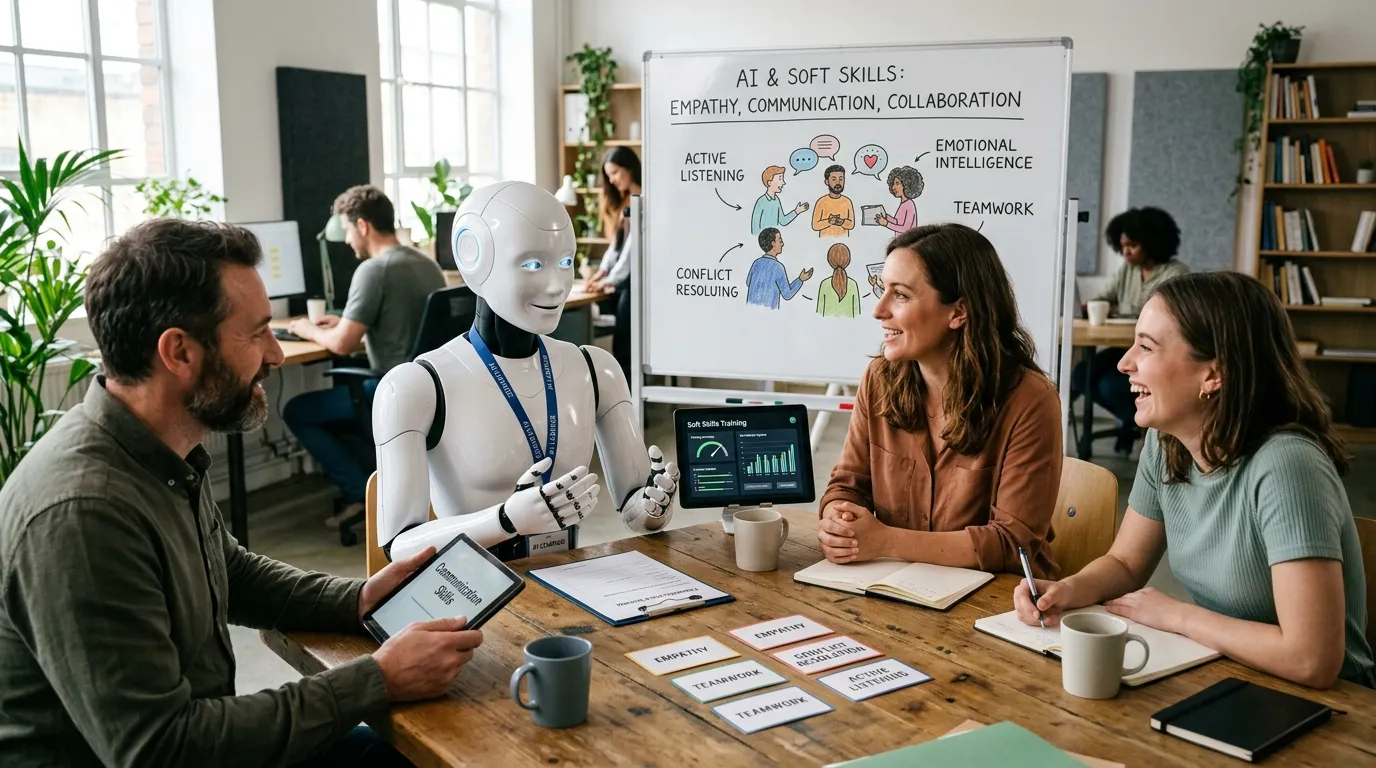
Artificial intelligence has changed the way people work, learn, and communicate. It can write emails, answer questions, analyze large amounts of data, and even create images in seconds. These abilities make AI useful in many industries. Still, one question continues to come up: Why can’t AI learn soft skills?
After using AI tools for different tasks, I noticed that they perform well with facts and patterns. However, they struggle in situations that need empathy, emotional understanding, or human judgment. AI can generate responses that sound caring, but it does not truly understand feelings or personal experiences.
Soft skills are personal abilities that help people communicate, solve problems, build trust, and work well with others. Unlike technical skills, they grow through real life experiences, relationships, feedback, and daily interactions. AI learns from data, while people learn from life. That difference explains why AI still cannot replace many human qualities.
In this article, I’ll explain the main reasons AI cannot truly learn soft skills and why these abilities remain valuable in schools, workplaces, and everyday life.
1. AI Has No Real Emotions
The biggest reason AI cannot learn soft skills is that it does not experience emotions. It can recognize emotional words and predict suitable responses, but it never feels happiness, sadness, fear, excitement, or compassion.
People develop soft skills because emotions shape how they react in different situations. For example, losing a loved one, celebrating success, or helping a friend creates emotional experiences that influence future decisions. AI has no emotional memory to learn from.
Instead, AI works by finding patterns in the data it has been trained on. If many people respond with comforting words during difficult situations, AI can generate similar responses. However, those responses come from probability, not genuine care.
This difference becomes clear during sensitive conversations. A human can adjust their tone based on emotions, while AI relies on learned language patterns.
Some key differences include:
- Humans experience emotions before responding.
- AI predicts responses from existing data.
- Humans build emotional memories over time.
- AI stores information without feelings.
- People connect through shared emotions.
- AI imitates emotional language without experiencing it.
That is why AI may sound empathetic, but it cannot truly understand what another person feels.
2. AI Lacks Real Life Experiences
Soft skills grow through everyday life. Every conversation, mistake, success, disagreement, and relationship teaches people something new. AI has no personal experiences, so it misses an important part of human learning.
For example, confidence often develops after overcoming challenges. Leadership improves through managing teams and solving real workplace problems. Patience grows by handling difficult situations over time. These lessons cannot simply be downloaded into an AI system.
Instead of living through experiences, AI analyzes text, images, videos, and other data created by humans. It learns patterns within that information but never participates in the events itself.
Human experiences that build soft skills include:
- Working with different personalities.
- Handling conflicts at school or work.
- Learning from personal mistakes.
- Receiving honest feedback.
- Building friendships and trust.
- Adapting to different cultures.
- Facing unexpected challenges.
Each experience changes how people communicate and make decisions in the future.
This explains why two people may respond differently to the same situation. Their experiences shape their judgment. AI does not have that personal history.
3. AI Learns From Data, Not Human Interaction
People improve soft skills by interacting with others every day. Conversations, teamwork, mentoring, and collaboration all help build communication and emotional awareness.
AI learns differently. It studies huge collections of text, images, audio, and videos to recognize patterns. Modern language models are trained using billions or even trillions of words collected from books, websites, articles, and other public sources. While this gives AI broad knowledge, it does not replace genuine human interaction.
For example, a customer service employee learns by speaking with customers, handling complaints, and adjusting their communication style. AI studies examples of those conversations but never experiences the pressure or emotions involved.
The difference is clear.
Humans learn through:
- Face to face conversations.
- Team projects.
- Workplace collaboration.
- Listening and observing others.
- Giving and receiving feedback.
AI learns through:
- Training datasets.
- Statistical patterns.
- Language prediction.
- Machine learning models.
- Continuous data processing.
Because of this, AI can explain communication techniques but cannot truly develop communication skills in the same way people do.
4. AI Cannot Fully Understand Context
Soft skills rely on context, not just words. People understand messages by combining tone of voice, facial expressions, body language, culture, and the situation. AI can analyze text and sometimes voice or images, but it may still miss the complete meaning.
Context affects communication in several ways:
- The same sentence can have different meanings depending on tone and facial expressions.
- Body language and eye contact often reveal emotions that words do not.
- Cultural differences can completely change how a message is understood.
- A joke between close friends may be inappropriate in a formal meeting.
- Managers adjust their communication based on an employee’s experience and confidence.
- Silence, pauses, and hesitation often carry meaning that AI may not fully recognize.
For example, when someone says, “I’m fine,” a friend may notice sadness from their voice or expression, while AI may interpret only the words. This is why understanding context remains one of the biggest challenges for artificial intelligence. Human communication depends on much more than spoken or written language.
5. AI Has No Emotional Intelligence
Emotional intelligence is the ability to recognize, understand, manage, and respond to emotions in yourself and others. It plays a major role in communication, teamwork, leadership, and conflict resolution.
Researchers often describe emotional intelligence through five main areas:
- Self awareness.
- Self regulation.
- Motivation.
- Empathy.
- Social skills.
People develop these abilities through years of personal growth and daily interactions. AI does not possess self awareness or emotional understanding, so it cannot develop emotional intelligence in the same way.
For example, an experienced teacher may notice when a student feels discouraged before they say anything. A good manager can recognize stress within a team and adjust their communication. These decisions come from observation, emotional awareness, and experience.
AI can detect emotional words, identify positive or negative sentiment, and recommend suitable responses. However, detecting emotions is very different from understanding them.
This difference explains why AI works well as an assistant but still relies on human judgment in emotionally sensitive situations such as healthcare, education, counseling, leadership, and customer relationships.
6. AI Cannot Build Genuine Relationships
Strong relationships are built on trust, honesty, shared experiences, and consistent actions over time. These qualities help people work together, solve problems, and support one another during difficult situations.
AI can keep a conversation going and answer questions quickly, but it does not build personal connections. It cannot remember what it feels like to earn someone’s trust because it has never experienced friendship, teamwork, or family relationships.
People build lasting relationships by:
- Keeping promises.
- Showing empathy during difficult times.
- Respecting different opinions.
- Learning from past interactions.
- Supporting others when they need help.
These actions create trust over months or years. AI can assist with communication, but it cannot replace the human bond that develops through real experiences.
This is why businesses still depend on people for customer relationships, leadership, mentoring, and negotiations. Trust comes from human interaction, not automated replies.
7. AI Cannot Make Human Based Ethical Judgments
Many soft skills involve making decisions that have no single correct answer. People often balance fairness, empathy, cultural values, and personal responsibility before choosing what to do.
AI does not have personal beliefs or moral values. It generates responses based on patterns in data instead of personal judgment.
For example, a manager deciding whether to give an employee another chance after a mistake may consider:
- The employee’s past performance.
- Personal circumstances.
- Team morale.
- Long term impact.
- Company values.
AI can list these factors, but it cannot personally weigh compassion against accountability.
Ethical decisions often change depending on the situation. What works in one culture or workplace may not work in another. Human judgment adapts to these differences, while AI depends on the information it receives.
That is why important decisions in healthcare, law, education, and business still require human oversight.
8. AI Struggles With Creativity in Human Situations
AI can generate poems, articles, presentations, and artwork within seconds. However, creative soft skills involve much more than producing content.
Human creativity often includes:
- Emotional storytelling.
- Original ideas shaped by experience.
- Creative leadership.
- Personal expression.
- Flexible problem solving.
AI supports creative work, but it does not replace the emotional depth behind many human ideas.
This is why creative professionals still play a key role even as AI tools become more capable.
9. AI Cannot Read Every Nonverbal Signal
Communication goes far beyond spoken words. Researchers estimate that much of human communication depends on nonverbal signals such as facial expressions, gestures, eye contact, posture, and tone of voice.
People naturally notice these signals during conversations and adjust their responses.
For example, someone may say they agree with an idea while avoiding eye contact and speaking with hesitation. A person may recognize uncertainty immediately, while AI could focus only on the spoken words.
Important nonverbal signals include:
- Facial expressions.
- Tone of voice.
- Body posture.
- Hand gestures.
- Eye contact.
- Silence and pauses.
These signals help people understand emotions that words alone cannot explain.
Although computer vision and speech recognition have improved, AI still struggles to interpret every signal accurately across different cultures and situations.
Because of this limitation, many conversations still require human observation and judgment.
10. AI Cannot Learn From Personal Growth
One of the greatest strengths of people is the ability to grow through experience. Every mistake, challenge, success, and failure teaches valuable lessons that shape future behavior.
Personal growth helps people become better leaders, communicators, parents, teachers, and coworkers.
For example, someone who once struggled with public speaking may become a confident presenter after years of practice and feedback. Another person may become more patient after managing difficult situations at work.
AI improves differently.
It becomes better through updated models, additional training data, and system improvements. It does not reflect on mistakes, feel regret, gain confidence, or develop self awareness.
Human growth includes:
- Learning from failure.
- Building confidence over time.
- Improving communication.
- Developing resilience.
- Reflecting on personal decisions.
- Adapting through life experiences.
These qualities continue throughout a person’s life. They cannot be copied simply by processing more information.
That is why soft skills remain deeply human, even as artificial intelligence becomes more advanced.
Frequently Asked Questions
Why can’t AI understand emotions?
AI can recognize emotional language and facial patterns, but it does not experience emotions. It predicts responses instead of feeling happiness, sadness, or empathy.
Can AI ever develop empathy?
AI can imitate empathetic responses, but genuine empathy comes from human emotions and lived experiences. Current AI cannot truly experience either.
Does ChatGPT have emotional intelligence?
No. ChatGPT can identify emotional cues and respond politely, but it does not have self awareness, emotional understanding, or personal feelings.
Can AI replace human communication?
AI can assist with communication tasks like writing and translation, but it cannot replace trust, emotional connection, or relationship building.
What jobs require soft skills the most?
Healthcare, education, leadership, counseling, customer service, sales, human resources, and management all depend heavily on soft skills.
Can robots learn empathy?
Robots can be programmed to recognize emotional signals and respond appropriately, but they do not genuinely feel empathy.
What is the difference between hard skills and soft skills?
Hard skills are technical abilities such as coding or accounting. Soft skills include communication, teamwork, leadership, adaptability, and emotional intelligence.
Can AI become self aware?
There is no evidence that current AI systems are self aware. They process information and generate outputs without consciousness.
Conclusion
Artificial intelligence has become smarter and more useful, but soft skills remain one of its biggest limits. AI can process huge amounts of information, recognize patterns, and generate human-like responses. However, it cannot feel emotions, build genuine relationships, develop emotional intelligence, or grow through personal experiences.
After exploring these reasons, one thing becomes clear. Soft skills are built through life, not data. Communication, empathy, leadership, creativity, ethical judgment, and trust come from years of interacting with people and learning from real situations. These qualities cannot be copied simply by training an AI model on more information.
This does not mean AI has no value. It can improve productivity, automate repetitive tasks, and support decision making. The best approach is to use AI as a tool while relying on human soft skills for conversations, leadership, teamwork, customer relationships, education, and healthcare.
Also Read: How To Use GetGlow AI?
